
The Future of Solar Panel Trade Between India and the Middle East
Table of Contents
Introduction
Why the Middle East Can’t Ignore India’s Solar Rise
What Makes Indian Solar Panels Stand Out?
The UAE’s Solar Ambitions: A Market That Needs Supply
Navigating the Trade: Logistics, Certifications & What to Watch Out For
How to Build a Reliable Supplier Relationship with India
Conclusion
FAQ
Introduction
Just a few months ago the conversation of a solar procurement manager in Dubai who needed panels at scale began and ended with China. That’s changing, faster than most people expect.
India has accomplished in two years what many people thought would take decades: it has become the clean energy manufacturing power on the planet. A country that was sinking billions of dollars into imports of solar modules just two years ago is shipping panels to the UAE, Africa and beyond. When you’re an importer in the UAE who is actually listening to what’s happening, this isn’t noise; it’s an opportunity.
If your thinking about importing solar panels from India to UAE, this article is your honest, on-the-ground analysis of what the market looks like, what manufacturers in India actually have to offer, and how to build partnerships that survive beyond the first shipment.
Why the Middle East Can’t Ignore India’s Solar Rise
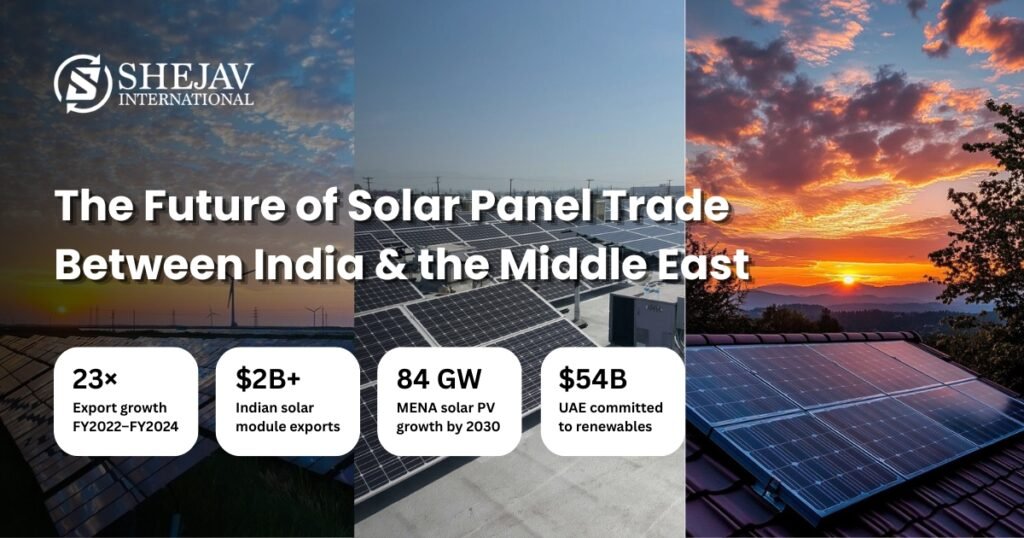
India’s solar manufacturing sector didn’t just grow — it exploded. Between FY2022 and FY2024, the export value of Indian solar modules grew more than 23 times over, crossing the $2 billion mark in a single fiscal year. That’s not incremental progress; that’s a structural transformation.
Two forces drove this. First, the Indian government’s Production Linked Incentive (PLI) scheme poured serious money into domestic manufacturing, pushing India’s module production capacity toward 110 GW by 2025–26. Second – and this is where it gets strategically interesting for Middle East buyers – the global “China Plus One” strategy became very real, very quickly. As the U.S. imposed steep tariffs on Chinese solar products and multiple regions grew anxious about supply chain concentration, India positioned itself as the credible alternative.
The UAE already features in India’s export ledger. It accounts for a small but growing share of Indian solar exports – and given the scale of what’s being built in the Gulf right now, that number has every reason to climb.
What Makes Indian Solar Panels Stand Out?
Let’s be honest: Indian panels aren’t always the cheapest option on paper. But price per watt is only one lens, and it can be misleading one.
Here’s what experienced importers tend to notice once they’ve worked with Indian manufacturers for a while:
Certification alignment. Indian manufacturers under the ALMM (Approved List of Models and Manufacturers) framework are producing to international quality benchmarks – IEC, BIS, and increasingly, IEC 61215 and 61730 standards that Middle East project developers and EPCs actually require.
Transparent supply chains. Post the Uyghur Forced Labor Prevention Act scrutiny on Chinese supply chains, Indian manufacturers offer something genuinely valuable: cleaner documentation trails. For large infrastructure projects in the UAE that may involve multilateral financing, this matters more than most buyers initially realize.
Competitive margins. Reports suggest Indian manufacturers can earn 40–60% higher margins on export sales versus domestic ones, which means they are actively motivated to compete internationally – including on service, lead times, and after-sales support.
Customization. India has a growing base of manufacturers who will work with buyers on custom wattages, frame specifications, and even packaging requirements – something that can be harder to negotiate with larger Chinese players who have less incentive to customize for mid-scale orders.
The UAE’s Solar Ambitions: A Market That Needs Supply
The numbers coming out of the UAE’s energy planning bodies are, frankly, staggering in the best way for anyone in the solar trade.
The UAE has committed $54 billion toward renewables and is on track — per the IEA’s Renewables 2024 report — to exceed its own 2030 renewable energy targets. Solar PV capacity across the MENA region is expected to grow by 84 GW by 2030, with more than half coming from Saudi Arabia and the UAE alone. Dubai’s Mohammed bin Rashid Al Maktoum Solar Park is headed toward 5 GW. The UAE holds three of the world’s largest solar installations.
But here’s the less discussed reality: large-scale utility projects get the headlines, while the commercial rooftop and mid-scale distributed solar segment is still dramatically underserved. This is where importers and distributors in the UAE have genuine room to build a business. Projects for warehouses, industrial zones, free zones, and residential developers are moving fast – and they need a reliable, cost-competitive supply of panels that don’t require six-month lead times.
India – geographically close, culturally familiar to a large section of the UAE business community, and increasingly competitive – is a natural fit for this demand.
Navigating the Trade: Logistics, Certifications & What to Watch Out For
Buying solar panels across international borders sounds straightforward until it isn’t. A few things that experienced importers flag:
Shipping routes and lead times. The India–UAE maritime corridor is one of the busiest in the world. Major Indian ports like Mundra, Nhava Sheva, and Pipavav handle regular container traffic to Jebel Ali. For buyers in the UAE, this means lead times from factory to port can be managed relatively efficiently – typically 15–30 days depending on manufacturer location and order size.
Customs and duties. The UAE imposes a 5% import duty on solar panels (HS Code 8541.40), though businesses operating in free zones may benefit from exemptions. Always verify with a UAE-based customs consultant before placing large orders.
Quality verification. Don’t skip third-party inspection. Reputable Indian manufacturers will welcome it; anyone who pushes back on pre-shipment inspection is a red flag. Use SGS, Bureau Veritas, or similar agencies for independent quality checks.
Payment terms. Most Indian exporters will initially work on Letter of Credit or advance payment for new relationships. As trust builds, 30–60 day credit terms become negotiable. Don’t accept verbal assurances – put everything in a well-drafted commercial contract.
Currency and hedging. The INR–AED exchange rate has been relatively stable, but for large orders, even small swings can affect landed cost. Consider forward contracts if you’re placing orders worth $250,000+.
How to Build a Reliable Supplier Relationship with India
One-off transactions rarely unlock the best pricing, priority allocation during high-demand periods, or technical collaboration. The most successful UAE importers treat their Indian counterparts as long-term partners — not just vendors.
A few things that actually work in practice:
Visit the factory at least once. A site visit does more for trust-building than six months of email threads. Manufacturers take buyers more seriously when they show up.
Start small, scale deliberately. Begin with a pilot order. Evaluate not just panel quality, but responsiveness, documentation accuracy, and how they handle a problem — because problems will happen.
Communicate seasonal demand patterns early. India’s manufacturing calendar has its own rhythms — Diwali shutdowns, monsoon logistics challenges, Q4 push. Planning around these with your supplier avoids nasty surprises.
Explore formal distribution agreements. If the relationship proves strong, a structured solar panel distributor partnership gives both sides better planning visibility and often unlocks preferential pricing.
Sourcing solar from India isn’t just about cost arbitrage — it’s about building a supply chain that makes your business in the UAE more resilient.
Conclusion
The relationship between India and the Middle East in the solar sector is moving from occasional transactions toward something that looks a lot more like a genuine trade corridor. India has the manufacturing scale. The UAE and its neighbors have the demand and the policy ambition. The geography, the cultural ties, and the trade infrastructure all support a closer relationship.
For importers and procurement teams in the UAE, the window to establish good supplier relationships — before competition for Indian manufacturing capacity intensifies further — is now. Whether you’re looking to buy solar panels from India for a one-off project or structure a longer-term supply chain strategy, the fundamentals of the India-UAE solar trade have never been more favorable.
The sun shines on both sides. The question is who’s positioned to make the most of it.
FAQ
1. Are Indian solar panels suitable for UAE’s desert climate? Yes. Look for panels certified to IEC 61215 and IEC 61730 standards, with low temperature coefficients and solid performance warranties for high-irradiance conditions.
2. What is the minimum order quantity when buying from an Indian solar panel exporter? Most exporters work with full container loads (FCL) – roughly 40–80 kW per 20-foot container. Smaller orders are possible through distributors, but FCL volumes unlock the best pricing.
3. How do I verify a solar panel supplier in India is legitimate? Check for IEC certifications and ALMM listing, ask for export client references, and run a third-party factory audit (SGS or Bureau Veritas) before committing to large orders.
4. What import duties apply when importing solar panels into the UAE? The standard rate is 5% (HS Code 8541.40). Free zone companies may be exempt – confirm with a licensed UAE customs broker before ordering.
5. Is a distributor partnership better than sourcing directly from Indian manufacturers? Start with a distributor to reduce friction on early orders, then move to direct sourcing as volumes grow. A hybrid approach — distributor first, direct later — tends to work best.
This article is intended for informational purposes for solar importers and procurement professionals in the UAE. Trade regulations, duty rates, and manufacturing capacities are subject to change — always verify current terms with qualified trade and legal advisors.
Partner with Shejav International
At Shejav International, we don’t just export products — we deliver trust, quality, and long-term partnerships. Join hands with us to experience seamless global trade backed by dedication, integrity, and a passion for excellence.