
Why Indian Solar Exporters Are Becoming Preferred Suppliers in the GCC Region
Table of Contents
Introduction
The Manufacturing Scale That Changed Everything
Why GCC Demand Creates a Natural Opening for India
Four Reasons Indian Suppliers Are Winning
Common Mistakes GCC Buyers Make When Sourcing from India
Future Outlook
Conclusion
FAQ
Sources & References
Introduction
Three years ago, a procurement manager at a Dubai EPC firm placing a bulk module order from anywhere other than China would have been making an unusual call. The pricing, the lead times, the product familiarity, everything pointed toward Shenzhen, not Gujarat or Tamil Nadu.
That calculus is shifting, faster than most people in the region have registered.
India’s solar manufacturing sector has undergone a structural transformation that few analysts predicted at this speed. What was a largely import-dependent industry in 2021 has, by 2025, become a credible global supplier — one that GCC-based distributors, EPC companies, and project developers are now actively courting. The reasons go well beyond price. They involve supply chain integrity, geopolitical alignment, quality certification, and the texture of doing business across a trade corridor that has existed for decades.
This article examines, with data and ground-level context, why Indian solar exporters have moved from an interesting alternative to a genuinely preferred option in the GCC market.
The Manufacturing Scale That Changed Everything
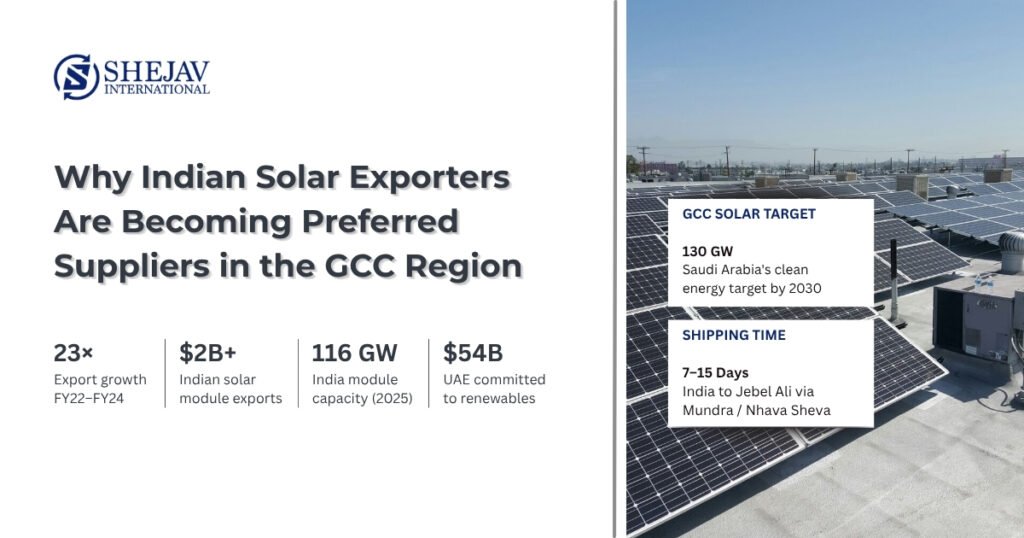
The headline number tells the story plainly. According to IEEFA, the export value of Indian solar PV modules grew more than 23 times between FY2022 and FY2024, crossing the $2 billion mark in a single fiscal year. That is not incremental progress , it is a structural shift in India’s position within the global supply chain.
The engine behind it has been the government’s Production Linked Incentive (PLI) Scheme for High-Efficiency Solar PV Modules, backed by a ₹24,000 crore (approximately $2.9 billion) outlay under MNRE. By mid-2025, PLI beneficiaries had installed around 11 GW of module manufacturing and 5 GW of solar cell manufacturing capacity under the scheme alone. Total national solar PV module manufacturing capacity crossed 116 GW by late 2025 , up from negligible scale five years earlier.
Technology quality is rising in parallel. TOPCon modules accounted for over 90% of new manufacturing capacity additions in the first half of 2025, with efficiency ratings in the 24–25% range and module classes of 600–720 Wp , specifications that align directly with what GCC utility and commercial projects are specifying. India is no longer just a volume supplier. It is producing premium-tier product that can genuinely compete in demanding markets.
The structural incentive to export is also real. Indian manufacturers can earn approximately 40–60% higher profit margins on international export sales versus the domestic market (IEEFA). When a GCC buyer engages an Indian solar panel supplier, they are dealing with a counterpart who is institutionally motivated to compete on service, responsiveness, and after-sales support, not just unit price.
Why GCC Demand Creates a Natural Opening for India
The Gulf Cooperation Council is not simply a region with solar ambitions. It is in the middle of executing some of the most aggressive energy transitions ever undertaken, on timelines that demand substantial, reliable module supply.
Saudi Arabia’s National Renewable Energy Program targets between 100 GW and 130 GW of clean energy by 2030, with solar as the lead technology. As of end-2025, the Kingdom had installed approximately 12 GW of solar capacity – meaning the procurement gap between current state and 2030 target is enormous. The UAE is equally ambitious: Dubai’s Mohammed bin Rashid Al Maktoum Solar Park is heading toward 5 GW, and EWEC is planning 7.3 GW of renewable capacity. Across the six GCC states, IRENA projects $76 billion in cumulative cost savings from renewable adoption by 2030.
Critically, the commercial and distributed solar segment – warehouses, industrial zones, free zones, residential developers — remains dramatically underserved relative to utility-scale headlines. These mid-scale buyers need reliable, cost-competitive supply without six-month lead times. India, close in geography and deeply familiar to a large portion of the UAE business community, fits that profile well. Shipping from Mundra or Nhava Sheva to Jebel Ali typically takes 7–15 days in transit, with total order-to-delivery windows of 3–5 weeks for organized procurement, faster than most Chinese competitors for Gulf buyers.
Four Reasons Indian Suppliers Are Winning
1. Supply Chain Transparency The US Uyghur Forced Labor Prevention Act (UFLPA) changed how multilateral-financed projects globally evaluate solar supply chains. For GCC developers working on internationally financed infrastructure or producing green hydrogen destined for ESG-conscious European buyers, Indian manufacturers, operating under the ALMM framework with domestic sourcing, offer documentation trails that are considerably cleaner to audit than Chinese alternatives.
2. China Plus One Diversification Multiple regions have been reducing supply chain dependence on Chinese manufacturers, not on quality grounds, but due to concentration risk. India has been the principal beneficiary. For GCC procurement teams, this means Indian solar module manufacturers are increasingly battle-tested on international quality, logistics, and documentation standards.
3. IEC Certification Alignment Indian manufacturers listed under the ALMM framework produce to IEC 61215 and IEC 61730, the same standards GCC project developers and EPCs require for commissioning. The quality floor in India has risen markedly in the last three years.
4. Flexibility on Mid-Scale Orders Large Chinese manufacturers have little incentive to customize specifications or prioritize mid-scale orders. Leading Indian solar PV module manufacturers, by contrast, will work with buyers on wattage specifications, frame requirements, and packaging, and they will answer your calls. That responsiveness has real operational value.
Common Mistakes GCC Buyers Make When Sourcing from India
These mistakes actually cost money. Worth naming plainly.
Treating all ALMM-listed manufacturers as equivalent. ALMM confirms a baseline, not a quality ceiling. Verify certifications for specific product models, request actual test reports, and check export references independently.
Skipping pre-shipment inspection. Third-party inspection from SGS or Bureau Veritas adds $1,500–$3,000 to an order. Skipping it on a $200,000 shipment is false economy. Any reputable Indian manufacturer will welcome it, pushback on inspection is a red flag.
Not accounting for India’s manufacturing calendar. Diwali shutdowns, monsoon logistics (June–September), and domestic Q4 demand surges all affect lead times. Communicate your procurement pipeline 60–90 days ahead.
Modeling ex-works price instead of landed cost. UAE import duty is 5% under HS Code 8541.40 (free zone exemptions may apply — verify with a customs broker). Add freight, insurance, and port handling before comparing India against any other source.
Skipping a contract and relying on verbal commitments. Indian solar panel prices can shift with polysilicon cycles and exchange rate movements. For any meaningful order, a formal commercial contract specifying price, quality benchmarks, delivery milestones, and penalties is not optional.
Future Outlook
The structural forces behind the India–GCC solar trade corridor are strengthening, not fading.
India’s manufacturing capacity, already past 116 GW for modules, continues to grow. As domestic Indian demand, substantial as it is remains outpaced by production capacity, the export incentive stays strong. GCC deployment requirements are scaling faster than any single supply source can comfortably serve. Saudi Arabia alone needs to add tens of GW annually to approach its 2030 target. No credible procurement strategy can be entirely single-sourced.
The green hydrogen dimension adds another layer. Both Saudi Arabia and the UAE have positioned green hydrogen as a strategic export industry, with European buyers as the primary market. That will eventually place ESG scrutiny on upstream solar supply chains. Indian solar companies, with their cleaner documentation, are positioned well for those requirements.
The India-UAE Comprehensive Economic Partnership Agreement (CEPA), signed in 2022, provides a formal bilateral trade framework that continues to mature. Administrative friction in cross-border procurement is reducing. Buyers who establish supplier relationships now, before competition for Indian manufacturing capacity intensifies, will be better positioned than those who wait.
Conclusion
The shift toward Indian solar exporters in the GCC is not marketing noise. It is driven by manufacturing scale, rising product quality, supply chain integrity, geographic proximity, and geopolitical logic. The two regions have complementary profiles: one with production capacity exceeding domestic demand, the other with deployment ambitions that no single supplier can fully serve.
For GCC procurement teams and distributors, the window to build strong supplier relationships with Indian solar module manufacturers — before that capacity gets fully committed — is open now. The fundamentals have rarely been more favorable.
FAQ
1. Are Indian solar panels suitable for GCC desert conditions? Yes, when correctly specified. Look for IEC 61215 and IEC 61730 certified modules with temperature coefficients below -0.35%/°C and anti-PID certification. Leading Indian solar module manufacturers now produce TOPCon modules with 24–25% efficiency ratings that perform well in GCC irradiance and heat conditions.
2. What is the minimum order quantity from Indian solar panel exporters? Most exporters work in full container loads (FCL) — roughly 40–80 kW per 20-foot container. Smaller volumes are accessible through distributors at a pricing premium. FCL volumes unlock the best direct pricing and allocation priority.
3. What import duties apply when bringing solar panels into the UAE? The UAE applies a 5% import duty under HS Code 8541.40. Free zone companies may be exempt depending on the zone and end-use. Verify your specific position with a licensed UAE customs broker before placing large orders.
4. What is the ALMM and why does it matter? ALMM (Approved List of Models and Manufacturers) is India’s MNRE-maintained quality framework. For GCC buyers, it is a useful initial filter — but treat it as a baseline, not a quality guarantee. Independent factory audits and certificate verification remain best practice.
5. Should GCC companies buy directly from Indian manufacturers or through a distributor? Start with a distributor for early orders and lower volumes — they reduce procurement friction and bring pre-vetted supplier relationships. Transition to direct sourcing as volumes and relationship confidence grow. The hybrid approach tends to be the most pragmatic path.
This article is for informational purposes for solar procurement professionals and distributors in the GCC. Trade regulations, duty rates, and manufacturing capacities are subject to change — verify current terms with qualified advisors before making procurement decisions.
Partner with Shejav International
At Shejav International, we don’t just export products — we deliver trust, quality, and long-term partnerships. Join hands with us to experience seamless global trade backed by dedication, integrity, and a passion for excellence.